
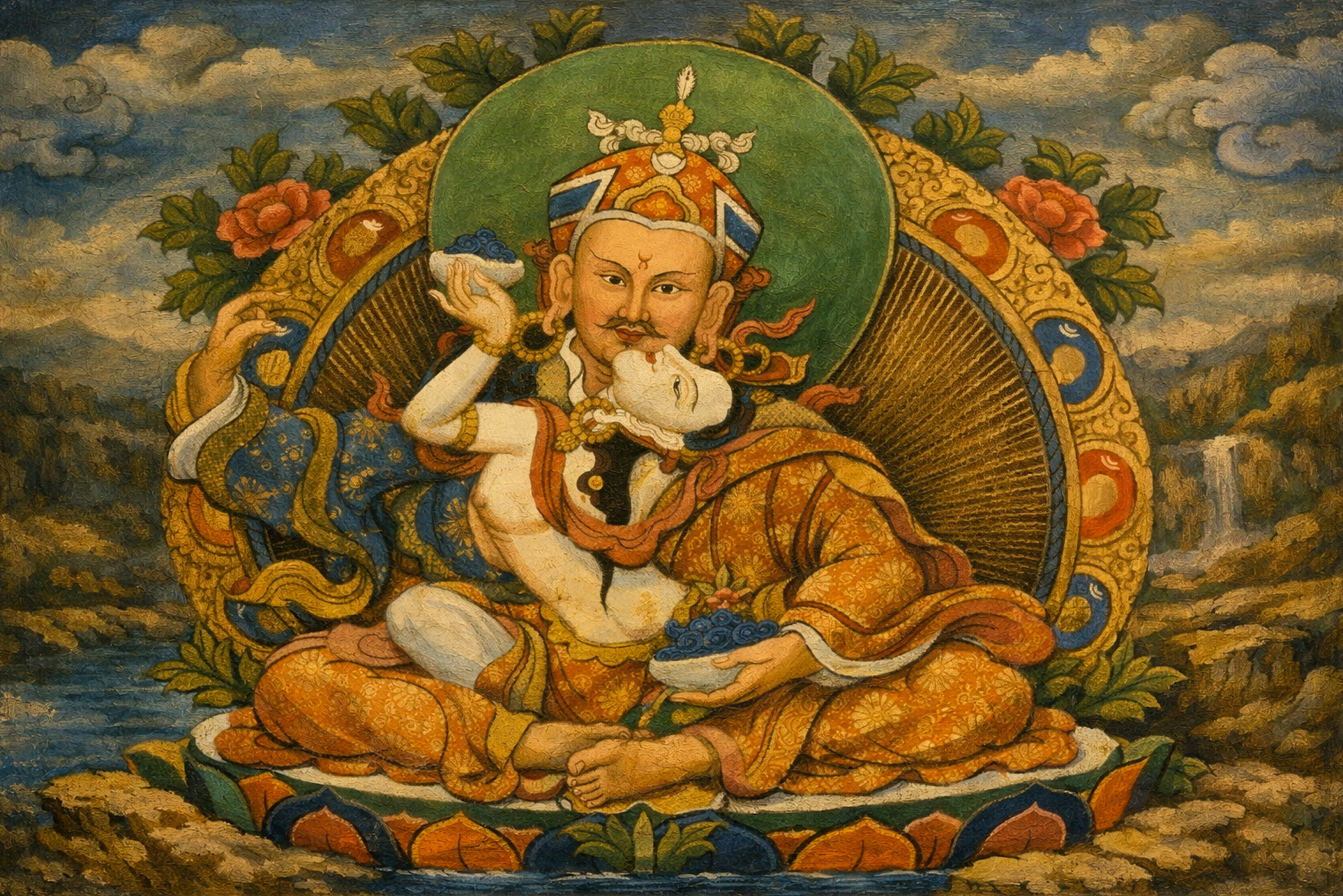
Yeshe Tsogyal (Tibetan: ཡེ་ཤེས་མཚོ་རྒྱལ་, Ye shes mtsho rgyal, “Queen of the Lake of Wisdom”) stands as one of the most important—and most complex—figures in Tibetan Buddhism. She is not remembered simply as a saintly woman or consort, but as a fully realized master, a founder of lineage, and the archetype of awakened feminine wisdom.
Within the Nyingma tradition, she is revered as the primary disciple and consort of Guru Padmasambhava, and equally as the first fully enlightened Tibetan woman. Her role bridges history, tantra, and living practice.
Born in the 8th century during the Tibetan imperial period, Yeshe Tsogyal lived at a time when Buddhism was being firmly established in Tibet. Historical and biographical sources describe her as a woman of royal background who renounced worldly status to devote herself entirely to spiritual practice.
Her life unfolds alongside the transmission of Vajrayāna into Tibet. She was not a passive recipient of teachings, but an active collaborator in their transmission, practice, and preservation. Many Tibetan sources explicitly credit her with mastering the most advanced tantric methods of her time.
Crucially, Yeshe Tsogyal is remembered as a key figure in the Terma tradition. Along with Padmasambhava, she concealed teachings (terma) intended for future generations, encoding them for later revelation by tertöns. In this role, she functions not only as a practitioner, but as a guardian of lineage across centuries.
Yeshe Tsogyal is often described as:
These descriptions should not be reduced to mythology. In Tibetan Buddhist understanding, they articulate function rather than biography. Yeshe Tsogyal represents the possibility that awakening is fully accessible within embodied human life, including female embodiment, which was often marginalized in other religious contexts.
Her title “Mother of Tibetan Buddhism” reflects this function. She nurtures, preserves, and transmits—without occupying the spotlight of institutional authority.
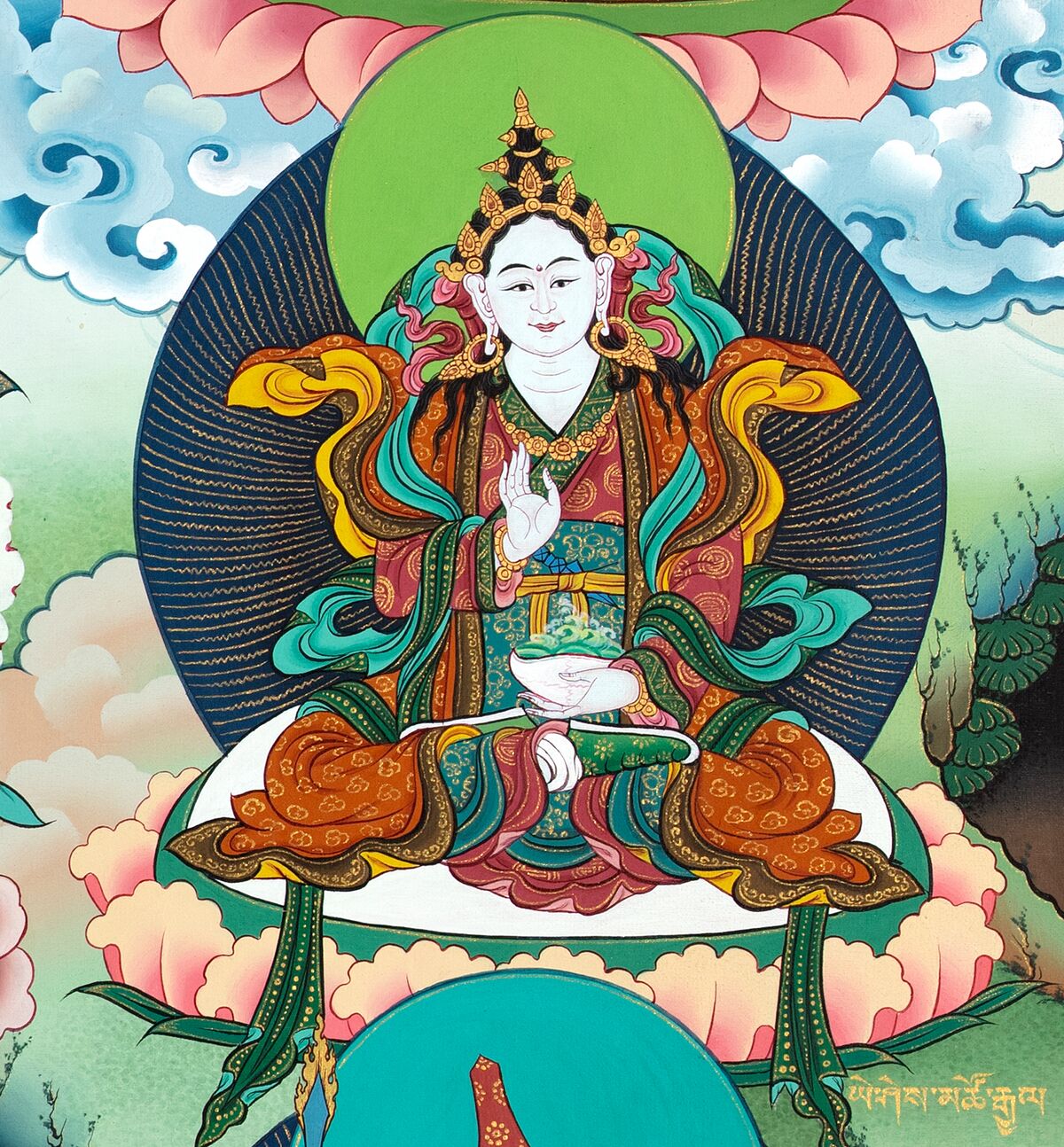
Biographical narratives consistently emphasize the severity of her training. Yeshe Tsogyal is portrayed as undertaking prolonged retreat, extreme asceticism, and direct confrontation with fear, isolation, and physical hardship. These accounts serve a pedagogical function: realization is shown to arise through direct engagement with suffering, not exemption from it.
Importantly, her practice is never portrayed as derivative. She attains realization in her own right, often described as equal to Padmasambhava’s. In many texts, she acts independently as a teacher, guide, and protector.
Within ritual and devotional life, she appears as:
Yeshe Tsogyal occupies a unique place in Tibetan cultural memory. She is invoked by practitioners—especially women—as proof that the highest realization is not gendered. At the same time, she transcends modern identity categories. Her significance lies not in representation alone, but in function: she demonstrates how wisdom operates through care, endurance, and precision.
In contemporary global Buddhism, Yeshe Tsogyal has become a touchstone for discussions of:
Yet within traditional Tibetan contexts, she is not debated—she is trusted.
To describe Yeshe Tsogyal as merely the consort of Padmasambhava is historically inaccurate and spiritually insufficient. To describe her only as a goddess is equally limiting.
She is remembered as:
Yeshe Tsogyal remains compelling because she embodies a truth Tibetan Buddhism has long maintained: awakening does not announce itself loudly. It sustains, protects, and returns again and again—like a lake fed by hidden springs.
Tibetan Buddhism developed within monastic and scholastic systems largely governed by men. Yet alongside these visible structures existed another mode of transmission—one grounded in retreat, oral instruction, service, and embodied practice.
Yeshe Tsogyal’s life exemplifies this mode. She did not found monasteries or author systematic treatises. Instead, she practiced relentlessly, transmitted teachings discreetly, and preserved lineages through concealment rather than proclamation. Her authority was earned through realization, not position.
In this sense, she did not break the system. She operated beneath it.

Later Tibetan histories often portray accomplished women as rare anomalies. The biographies themselves tell a different story. From Machik Labdrön to Nangsa Öbum, from wandering yoginīs to unnamed retreatants, women appear repeatedly as practitioners who attained realization through hardship, solitude, and unwavering discipline.
Yeshe Tsogyal becomes the archetype of this pattern. Her story establishes that female embodiment is not an obstacle to awakening but a fully workable ground for Vajrayāna practice.
Importantly, she is never depicted as transcending femininity to achieve realization. Her life includes vulnerability, endurance, care, and resilience—qualities not erased, but refined into wisdom.
One of the most striking features of Yeshe Tsogyal’s legacy is its quietness. She does not dominate ritual space. She does not demand visibility. Instead, she sustains transmission through fidelity, memory, and precision.
This quiet power shaped generations of women practitioners who followed her example—not by imitation, but by recognition. They saw that awakening did not require permission.
In modern conversations about gender and Buddhism, Yeshe Tsogyal is sometimes recruited as a symbol. Within the tradition itself, she functions differently. She is not an argument. She is evidence.
Her presence demonstrates that Tibetan Buddhism has always contained pathways of realization that do not rely on hierarchy, charisma, or institutional authority. These pathways survive because they are functional, not because they are celebrated.
Yeshe Tsogyal matters not because she was exceptional, but because she was foundational. She reminds us that much of what sustains a tradition does so quietly—through lives of practice that history only partially records.


