
Guru Padmasambhava, known in Tibetan sources as Padma ’byung gnas (པདྨ་འབྱུང་གནས་), occupies a position in Tibetan Buddhism that resists simple categorization. He is neither confined to the status of a historical missionary nor reducible to a mythic symbol constructed by later traditions. Instead, Padmasambhava functions as a living axis of authority through which tantric transmission, ritual legitimacy, and spiritual realization continue to be articulated.
This study approaches Padmasambhava not by attempting a comprehensive biography, but by examining how Tibetan sources themselves frame his presence: as a figure whose historical trace, visionary activity, and posthumous agency remain inseparable. Focusing on early historiographical records, Nyingma treasure literature, and ritual usage, this first part argues that Padmasambhava should be understood as a structural principle within Tibetan Vajrayana, rather than merely an individual of the eighth century.
Padmasambhava emerges in Tibetan sources within a precise historical window: the mid to late eighth century, during the reign of King Khri Srong lde btsan (Trisong Detsen, ca. 742–797). This was a period of intense political centralization and cultural experimentation. Tibet was transforming from a militarized empire into a Buddhist state, actively importing Indian religious specialists, translators, and ritual systems.
The introduction of Buddhism was neither smooth nor uncontested. Indigenous ritual specialists, often grouped retrospectively under the category of Bon and local spirit cults, held significant authority over land, health, and legitimacy. Buddhist sources consistently frame this period as one of instability, ritual conflict, and resistance.
Padmasambhava enters Tibetan history not as a philosopher or institutional founder, but as a ritual specialist whose function was to mediate between imported Buddhist cosmology and indigenous Tibetan forces.
This context explains why Tibetan sources emphasize subjugation, binding, and oath-taking rather than doctrinal debate.
From a historiographical perspective, this motif functions symbolically rather than biologically. It signals non-ordinary origin and authority independent of clan or caste, a crucial point in a Tibetan context where lineage legitimacy mattered deeply.
Tibetan sources consistently identify Uḍḍiyāna as a northwestern Indian or Central Asian region associated with tantric innovation. While its precise geographic identification remains debated, its symbolic function as a liminal tantric homeland is clear.
Guru Padmasambhava occupies an unusual position in the study of Tibetan Buddhism. He is simultaneously central and elusive, foundational and resistant to conventional historical framing. Unlike figures such as Śāntarakṣita or Atiśa, whose lives can be partially reconstructed through court records, inscriptions, and contemporaneous Indian sources, Padmasambhava emerges primarily through Tibetan narrative traditions that refuse to separate history from religious function.
This tension has long unsettled modern scholarship. From a strictly positivist perspective, Padmasambhava appears problematic: his biographies are layered, retrospective, and deeply symbolic; his deeds unfold in mythic registers; his chronology remains fluid. Yet within Tibetan Buddhism itself, none of this undermines his authority. On the contrary, it is precisely this mode of appearance that secures it.
The difficulty, therefore, does not lie in the sources alone but in the questions we bring to them. If Padmasambhava is approached solely as a historical individual whose legitimacy depends on verifiable dates and external corroboration, the tradition will always seem excessive or unreliable. If, however, he is examined as a figure whose authority operates through ritual efficacy, doctrinal necessity, and lived practice, a different picture emerges.
From the Tibetan perspective, Padmasambhava is not remembered in order to be placed in a timeline. He is recalled because he continues to function. His presence is activated whenever obstacles exceed ordinary means, whenever institutional forms prove insufficient, whenever the path demands methods that cut directly through fear, fixation, and resistance. This is why his name appears most insistently in moments of crisis, both personal and collective.
Early Tibetan sources already reflect this orientation. Texts such as the Zang gling ma and later Padma bka’ thang traditions do not present Padmasambhava as a passive transmitter of Indian Buddhism. They portray him as an agent who reshapes the conditions under which Buddhism can take root in Tibet. He subdues hostile forces, negotiates with local spirits, conceals teachings for future generations, and establishes ritual frameworks designed to endure instability. These narratives should not be read as naïve myth-making. They articulate a theory of religious authority suited to a volatile frontier context.
From my perspective as a scholar of Tibetan Buddhism, the insistence on asking whether Padmasambhava “really existed” in the narrow historical sense misses the more consequential issue. The tradition never positioned him as a figure whose significance depends on empirical confirmation. His authority rests instead on continuity of function. Padmasambhava matters because practices attributed to him continue to work, texts associated with his name continue to orient communities, and ritual systems framed through his presence continue to stabilize Buddhist life in Tibet.
This functional continuity explains why Padmasambhava remains indispensable across centuries. He is not replaced by later scholastic refinement, nor rendered obsolete by institutional maturity. Even in periods when monastic systems flourished and philosophical traditions reached high levels of sophistication, Padmasambhava retained a distinct role. He stands for a mode of Buddhism that operates when structure alone is insufficient.
Understanding Padmasambhava, then, requires a shift in analytical posture. Rather than forcing him into categories borrowed from modern historiography, it is more productive to examine how Tibetan Buddhism itself defines authority, memory, and efficacy. In that framework, Padmasambhava is neither an embarrassing legend nor a simple historical founder. He is a principle embodied as a person, a reservoir of methods designed for moments when the path encounters its limits.
This study begins from that recognition. Padmasambhava will not be treated as a problem to be solved or a myth to be explained away. He will be approached as a living axis around which Tibetan Buddhist practice, transmission, and imagination continue to turn.
Any historical discussion of Padmasambhava must begin by recognizing a fundamental tension in Tibetan sources. His life is richly detailed, yet deliberately resistant to ordinary biographical conventions. Names shift, locations multiply, and events unfold according to symbolic necessity rather than linear chronology. This reflects a Tibetan understanding of history in which religious function matters more than documentary precision.
Padmasambhava is most widely known as Guru Rinpoche, “the Precious Master,” a title emphasizing role rather than lineage. Early texts also identify him as Padma ’byung gnas, “the Lotus-Born,” anchoring the narrative of his extraordinary appearance.
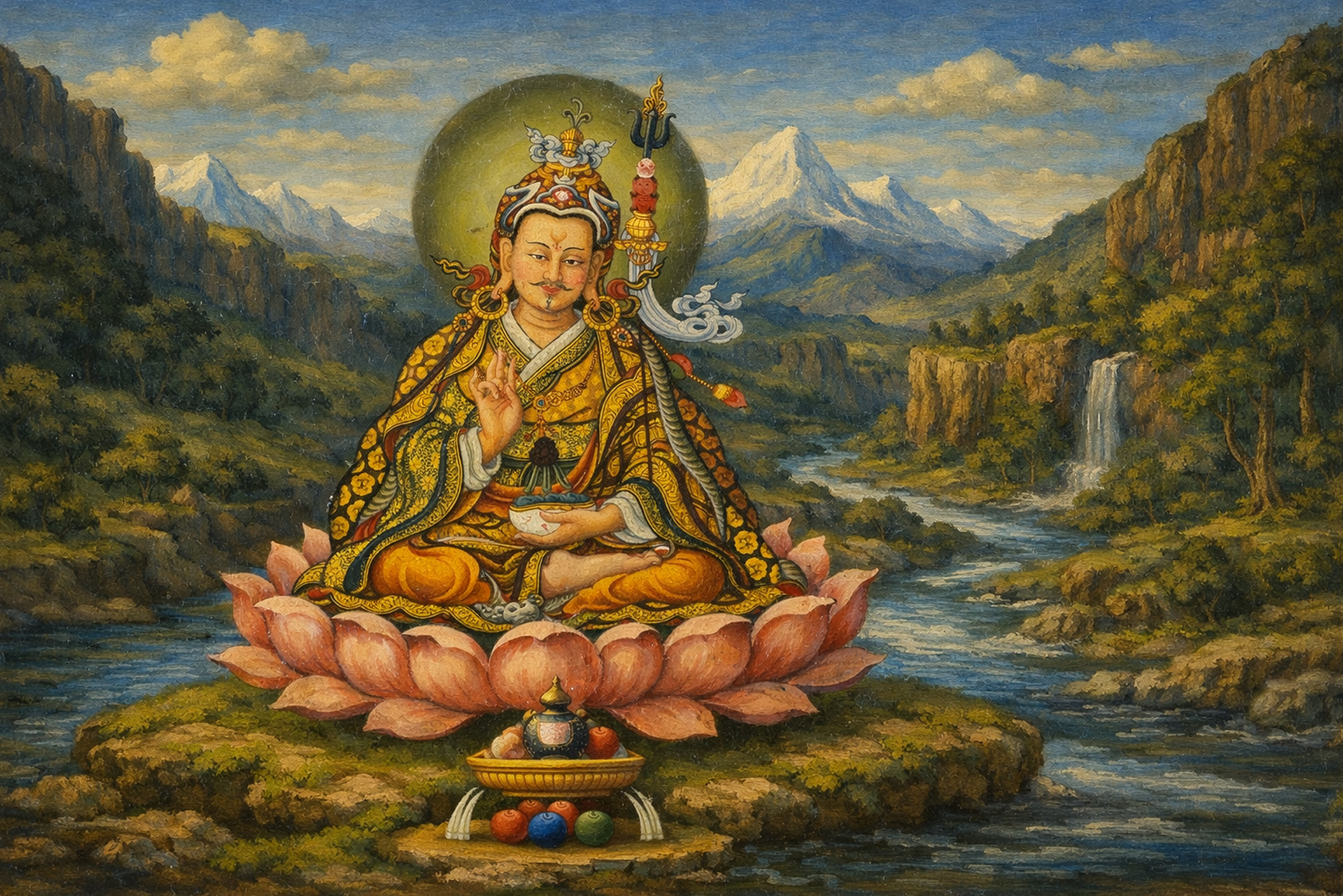
According to the Zang gling ma, Padmasambhava did not enter the world through ordinary birth. He appeared fully formed upon a lotus floating on Lake Dhanakośa in Oḍḍiyāna. The Tibetan phrasing is explicit:
མེ་ཏོག་པདྨ་ལས་བྱུང་བ་
Padma las byung ba
Born from a lotus
Rather than negating historicity, this narrative establishes a specific tantric legitimacy. In Vajrayāna thought, origin determines capacity. Birth from a lotus signifies spontaneous purity and freedom from ordinary karmic causation. Padmasambhava’s authority thus rests on realization, not institutional ordination or scholastic pedigree.
Historically, Oḍḍiyāna is not a mythic land. It corresponds to regions of the Swat Valley, known between the seventh and eighth centuries for siddha communities, tantric experimentation, and non-monastic transmission networks. Tibetan sources consistently place Padmasambhava within this milieu, explaining his divergence from Indian scholastic Buddhism.
This background clarifies his contrast with figures such as Śāntarakṣita. Where Śāntarakṣita embodies institutional and philosophical synthesis, Padmasambhava represents the siddha model: pragmatic, ritually adept, and responsive to crisis. His authority is operational before it is doctrinal.
When Padmasambhava is invited to Tibet during the reign of Khri Srong lde btsan, he is not summoned primarily to teach doctrine. He is called to resolve obstruction. Tibetan narratives describe Buddhism’s early difficulties as arising from hostile forces and destabilizing conditions rather than philosophical inadequacy.
Padmasambhava’s intervention takes the form of negotiation rather than eradication. Indigenous deities are bound by oath and integrated as protectors through dam tshig, a term emphasizing relational obligation. This strategy allows Buddhism to take root without erasing Tibetan cosmology.
From my perspective, the lotus birth narrative must be read in this functional context. It signals a form of authority capable of operating where conventional religious structures fail. Tibetan memory preserves Padmasambhava not as a founder of institutions, but as a figure who reconfigured the conditions under which Buddhism could survive.
Padmasambhava should not be understood merely as a transmitter of Indian Vajrayāna into Tibet. His most consequential contribution lies elsewhere: the establishment of the Terma system as a method for regulating how Buddhist authority, memory, and practice unfold across time.
This system did not preserve the past. It actively reorganized the future.
In Tibetan sources, Terma (གཏེར་མ་) refers to teachings intentionally concealed to be revealed later, when conditions are suitable.
The foundational claim appears repeatedly in early Nyingma literature:
གུ་རུ་པདྨས་ཆོས་གཏེར་དུ་སྦས་པ།
Guru Padma concealed the Dharma as treasures.
This is not symbolic language. Tibetan historians treated Terma as a concrete historical mechanism.
Historically, Terma served three functions:
In this sense, Terma functioned as a time-delayed transmission system.
From a historical perspective, the Terma system represents a radical departure from Indian Buddhist models.
Indian Buddhism emphasized:
Padmasambhava’s model introduced a different logic:
I consider this not an accident of myth-making, but a deliberate response to Tibet’s volatile political and geographic conditions during the imperial period.
Early Tibetan Buddhism faced repeated disruptions: imperial collapse, persecution, fragmentation of institutions.
Under such conditions, uninterrupted lineage transmission was structurally impossible.
Terma resolved this problem by reframing discontinuity itself as a feature, not a failure.
Key Terma texts explicitly state that revelation depends on karmic timing rather than institutional continuity:
དུས་ལ་བབ་པའི་སྐལ་ལྡན་གྱིས་གཏེར་འབྱེད།
Treasures are revealed by those with fortune when the time has ripened.
This formulation shifts authority from institutions to time, circumstance, and realization.
The tertön (གཏེར་སྟོན་) is not a passive discoverer.
Historically, tertöns functioned as:
Their authority did not rest on scholastic mastery alone, but on a recognized resonance between concealed intent and present conditions.
This explains why Terma revelations often appeared during periods of crisis.
Without Padmasambhava’s Terma framework, Tibetan Buddhism would likely have fractured into regional ritual cults or collapsed under political pressure.
Instead, it developed:
In this sense, Padmasambhava’s most enduring legacy is not a specific teaching, but a historical architecture that allowed Tibetan Buddhism to survive instability without losing coherence.
Understanding Padmasambhava through the Terma system forces a reconsideration of how history operates in Tibetan Buddhism.
What appears mythological on the surface often encodes pragmatic solutions to real historical problems.
The next section turns to how this logic shaped Padmasambhava’s posthumous presence in ritual, iconography, and lived religious memory.
In Tibetan Buddhism, Padmasambhava does not recede into history after the completion of his earthly activities. Unlike figures whose authority is preserved primarily through texts or institutions, Padmasambhava remains ritually present. His posthumous life unfolds through iconography, liturgy, and communal memory.
This persistence is not devotional excess. It reflects a distinctive Tibetan understanding of enlightened presence: realization does not terminate with death, nor does it require physical continuity.
Early Nyingma sources consistently emphasize that Padmasambhava’s activity continues through emanation and ritual accessibility:
གུ་རུ་རིན་པོ་ཆེ་ནི་སྐུ་གསུམ་ལས་མ་འདས།
Guru Rinpoche never departs from the three bodies.
This statement grounds his ongoing presence not in legend, but in Mahāyāna and Vajrayāna ontology.
Padmasambhava’s iconography is unusually rich and internally differentiated. This is not aesthetic variation, but doctrinal encoding.
Across thangka traditions, he appears in multiple forms, each corresponding to a mode of enlightened activity rather than a biographical episode.
The most canonical iconographic forms include:
Guru Tsokye Dorje (མཚོ་སྐྱེས་རྡོ་རྗེ)
Padmasambhava as lotus-born master, emphasizing non-ordinary origin and spontaneous presence.
Guru Padma Gyalpo (པདྨ་རྒྱལ་པོ)
Royal form, associated with magnetizing activity and sovereign authority over obstacles.
Guru Dorje Drolo (རྡོ་རྗེ་གྲོ་ལོད)
Wrathful manifestation, representing forceful compassion that subdues hostile forces and internal fixation.
These forms do not depict psychological moods. They articulate distinct operational modes of awakened activity.
From a ritual perspective, iconography functions as a map of how realization engages conditions, not as portraiture.
Padmasambhava’s presence in Tibetan life is sustained through ritual cycles rather than doctrinal study alone.
The Guru Yoga of Padmasambhava occupies a central place in Nyingma daily practice. Unlike more abstract contemplations, Guru Yoga explicitly frames the teacher as a living conduit of realization.
The Seven-Line Prayer (ཚིག་བདུན་གསོལ་འདེབས་) remains the most widespread invocation:
ཨོཾ་ཨཱཿཧཱུྂ
ཨུ་རྒྱན་ཡུལ་གྱི་ནུབ་བྱང་མཚམས།
In the northwest land of Uddiyana…
This prayer is not treated as historical remembrance. It is recited as an immediate summons.
Within Tibetan ritual logic, Padmasambhava is accessible not because he once lived, but because realization is not temporally bound.
Beyond monasteries, Padmasambhava occupies a central role in Tibetan folk religion. This dimension is often overlooked in academic treatments that privilege textual sources.
In village contexts, Padmasambhava is invoked for:
Protection during travel
Pacification of illness and misfortune
Harmonization of land and spirits
Guidance during death rites
Local rituals often blend canonical liturgy with regional oral tradition. Rather than diluting orthodoxy, this reflects the adaptability built into Padmasambhava’s legacy.
I view this not as syncretism born of ignorance, but as a continuation of Padmasambhava’s original role as mediator between Buddhist cosmology and indigenous Tibetan worlds.
Padmasambhava’s enduring authority rests less on historical verification than on functional continuity.
He remains present because his figure answers ongoing needs:
Tibetan Buddhism did not preserve Padmasambhava as a distant founder. It retained him as a living reference point for how awakened activity responds to disorder.
In this sense, Padmasambhava functions as a perpetual threshold figure, standing between past and present, doctrine and practice, institution and lived experience.
If Terma reorganized time, iconography and ritual reorganized memory. Together, they ensured that Padmasambhava did not become confined to history.
The next section examines how this living presence shaped Tibetan religious identity itself, and why Padmasambhava became indispensable not only to Nyingma, but to Tibetan Buddhism as a whole.
Although Padmasambhava is most explicitly associated with the Nyingma school, his function in Tibetan Buddhism exceeds sectarian boundaries. Historically and ritually, he operates as a structural figure, one whose presence stabilizes the tradition as a whole.
What distinguishes Padmasambhava from other foundational figures is not doctrinal originality in the narrow sense, but architectural impact. He shaped how Tibetan Buddhism relates to:
Authority without centralization
Continuity without linear transmission
Practice without dependence on permanent institutions
This explains why his influence persists even in traditions that do not center him explicitly in their philosophical curricula.
Tibetan Buddhism never developed a single centralized authority comparable to ecclesiastical systems elsewhere. This posed a persistent risk of fragmentation.
Padmasambhava’s legacy addressed this vulnerability by relocating authority from institution to realization mediated through practice.
Through Terma, Guru Yoga, and ritual invocation, authority became:
Personal yet non-individualistic
Lineage-based yet adaptable
Rooted in experience rather than administration
I see this as a decisive factor in the tradition’s ability to survive repeated political collapse without doctrinal disintegration.
Tibetan history is marked by cycles of disruption: imperial decline, sectarian conflict, invasion, exile.
Under such conditions, practices requiring stable institutions alone could not endure. Padmasambhava’s system privileged methods that remained functional even when:
Monasteries were destroyed
Texts were lost
Teachers were scattered
Guru Yoga, mantra, and ritual visualization do not require infrastructure. They require relationship and memory.
This is why Padmasambhava remains central wherever Tibetan Buddhism is practiced in fragile conditions, including diaspora communities today.
Padmasambhava’s prominence also reflects a deeper psychological and cultural function.
He is consistently invoked in moments of crisis: fear, illness, death, uncertainty. His wrathful forms are not expressions of aggression, but technologies for confronting destabilizing forces without denial.
In Tibetan religious imagination, Padmasambhava occupies the threshold between:
Order and chaos
Fear and confidence
Collapse and transformation
This role cannot be fulfilled by abstract doctrine alone. It requires a figure who embodies decisive, compassionate intervention.
From the standpoint of advanced practice, Padmasambhava represents a convergence point between scholarship and realization.
For scholars, his figure challenges rigid distinctions between history and myth. Tibetan sources do not ask whether Padmasambhava “really existed” in the modern historiographical sense. They ask whether his presence continues to function.
For practitioners, Padmasambhava offers a model of awakened activity that does not retreat from complexity. His legacy legitimizes engagement with danger, contradiction, and uncertainty as sites of practice.
I regard this integration as one of the most mature expressions of Vajrayāna thought.
Padmasambhava’s enduring significance lies not in the details of his biography, but in the structures he left behind. Through Terma, ritual presence, and iconographic plurality, he enabled Tibetan Buddhism to remain alive under conditions that would have fractured less adaptable traditions.
He is remembered not because the past demands remembrance, but because the present continues to require him.
This, more than any historical claim, explains why Guru Padmasambhava remains indispensable to Tibetan Buddhism today.


