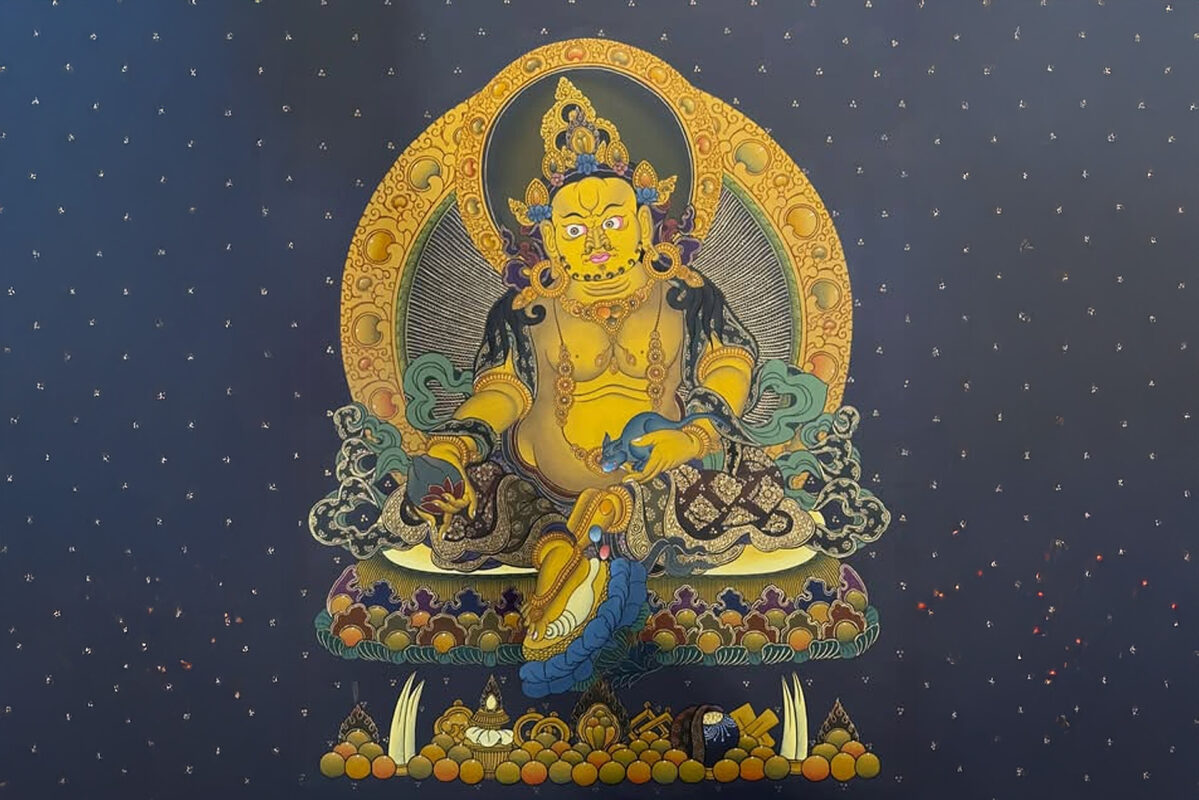
Among the many protective deities of Tibetan Buddhism, Yellow Dzambhala holds a distinctive place. He is not merely a “god of wealth,” as casual descriptions often suggest. Instead, he stands as a tantric embodiment of generosity, abundance, and the transformative energy of enlightened compassion. His presence appears throughout Himalayan art, especially in thangka painting, where every detail—every jewel, every color, every gesture—communicates a doctrinal message.
In classical interpretations, Yellow Dzambhala is regarded as a compassionate emanation of Vajrapāṇi, the bodhisattva who embodies the power of all buddhas. Several treasure texts (gTer ma) describe him as arising from Ratnasambhava’s wisdom-family, radiating the quality of equanimity that sees all beings as worthy of nourishment. The Kālacakra Tantra also includes him among the deities associated with the enrichment activities (rgyas pa’i phrin las), linking wealth with the expansion of inner capacity.
Yellow Dzambhala’s role is therefore broader than material prosperity. He manifests the principle that abundance is both a condition and a path, a field of merit that allows practitioners to practice without the burden of scarcity.
Abundance (Ratna) as the nature of reality
In Vajrayana, “wealth” is not crude or materialistic.
Wealth means the inexhaustible expression of the dharmadhātu.
Yellow Dzambhala represents:
• The abundance of wisdom,
• The abundance of compassion,
• The abundance of skillful means.
Blessings for both material and spiritual well-being
This form is invoked to:
• Purify karmic patterns of poverty,
• Increase merit,
• Expand “inner wealth,” such as joy, patience, and generosity.
A protector practice rooted in compassionate enrichment
Traditional texts emphasize that Dzambhala does not grant wealth on demand.
Rather, he provides the conditions for practitioners to:
• Create virtuous karma,
• Remove financial obstacles that hinder practice,
• Develop dāna pāramitā, the perfection of giving.
A mandala of the Wisdom of Equality
As a deity of the Ratna Family, Dzambhala teaches that wealth and poverty become equalized when seen through the lens of non-dual wisdom. With this view, both are workable, both teach, and both can ripen the mind.
Meaning in Practice
The mantra of Yellow Dzambhala is: OM DZAMBHALA DZALENDRAYE SOHA
Practitioners recite it to:
• Clear financial obstacles,
• Open the heart of generosity,
• Cultivate the wisdom that perceives the innate richness of mind.
During rituals, water is often poured over Dzambhala’s image to symbolize the continuous flow of blessings.
Yellow Dzambhala is central in many Vajrayana rituals. In enrichment practices—rgyas pa’i cho ga—he is invoked to remove the karmic poverty that prevents practitioners from dedicating time, energy, and resources to the path. His mantra, OM DZAMBHALA DZALENDRAYE SOHA, is traditionally recited with water offerings, symbolizing the continual flow of blessings.
Importantly, Dzambhala does not function as a deity of transactional prosperity. Treasure texts repeatedly warn against using his practice to feed attachment. Instead, he is seen as supporting the conditions that allow dharma to flourish. When the Dudjom Tersar describes him, it emphasizes that the true wealth he offers is “the wealth of merit and the wealth of wisdom.”
Thus, the presence of Dzambhala in a thangka does not simply promise gain. It teaches the practitioner to cultivate generosity, fearlessness, and an open-hearted relationship with resources—inner and outer.
The figure in the thangka is Yellow Dzambhala, an emanation of Vajrapāṇi, embodying abundance, wisdom, and spiritual richness. The thangka is not merely a wish for prosperity. It expresses the blessing-activity of the Ratna Family and reminds practitioners that the greatest form of wealth is a generous heart supported by the wisdom that sees all beings as equal.
A thangka of Yellow Dzambhala is more than devotional art. It is a doctrinal mirror. It reflects how Tibetan Buddhism understands prosperity—not as accumulation, but as release; not as private gain, but as the expansion of one’s ability to give. At a deeper level, Dzambhala represents the wealth inherent in the mind itself, the spaciousness from which generosity naturally flows. Thus, to encounter this thangka is to encounter a teaching: abundance is not something to chase. It is something to recognize, cultivate, and share.