
Every survival instinct says: move away from pain. Protect the self. Breathe in the clean air, exhale what is spent. The entire biological logic of the organism runs in one direction.
Tonglen runs the other way.
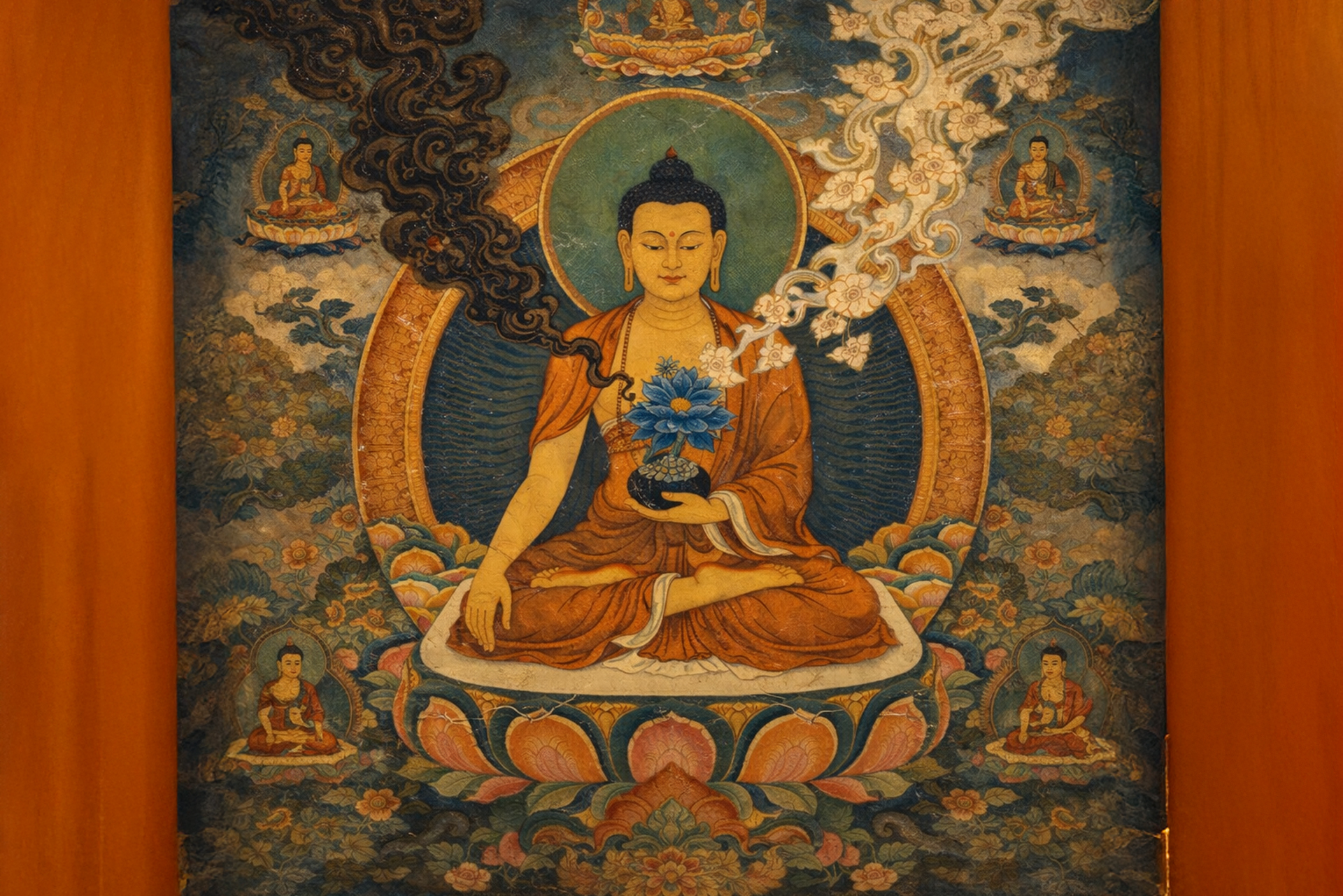
This is not accidental. The reversal is the point. Tonglen (Tib. གཏོང་ལེན།, “giving and taking”) is a meditation practice from the Tibetan Buddhist Lojong tradition that deliberately inverts the habitual orientation of the self-protective mind. You breathe in darkness, suffering, heat, constriction. You breathe out light, relief, space, coolness. You do this with full awareness of what you are doing and why.
For someone encountering this for the first time, the natural response is skepticism, or even alarm. Taking in suffering intentionally sounds like a recipe for psychological damage. The tradition’s answer is patient and precise: the practice works exactly because of that alarm. The resistance is the thing being trained.
Tonglen does not stand alone. It is a core practice within Lojong (Tib. བློ་སྦྱོང་།), which translates as “mind training” or more precisely “refining the mind.” Lojong is a systematic curriculum of practices and aphorisms designed to dismantle the self-cherishing orientation that Tibetan Buddhist psychology identifies as the root of suffering.
The Lojong teachings were codified in Tibet primarily through the Kadampa school, tracing back to the Indian master Atisha (982–1054 CE) and his student Dromtönpa. The most widely studied Lojong text is the Seven Points of Mind Training by Chekawa Yeshe Dorje (1101–1175), which systematizes the earlier Eight Verses of Mind Training by Langri Tangpa. Both texts are compact, aphoristic, and deliberately counter-intuitive. They function less like philosophical treatises and more like surgical instruments for dismantling habitual mental patterns.
Tonglen is the experiential, embodied core of Lojong. The aphorisms provide the view. Tonglen provides the practice through which that view is metabolized into direct experience.
Before examining the method, the underlying diagnosis matters. Tibetan Buddhist psychology identifies bdag ‘dzin (self-grasping) and bdag gi ‘dod chags (self-cherishing) as the two foundational dysfunctions of unawakened experience.
Self-grasping is the structural misperception that there is a fixed, independent self at the center of experience. Self-cherishing is the habitual prioritization of that imagined self’s comfort, safety, and continuity above all else.
These two are not moral failings. They are, in the tradition’s analysis, deeply conditioned patterns that operate below conscious reflection. The person who recoils from another’s suffering is not bad. They are simply running the default program. Tonglen is a practice specifically designed to interrupt that default, repeatedly and systematically, until a different pattern becomes the new normal.
Pema Chödrön, one of the most accessible modern teachers of Tonglen in the Tibetan tradition, describes the target of the practice with precision: it is the armoring of the heart, the reflexive contraction that occurs whenever experience threatens to be too much. Tonglen trains the practitioner to meet that contraction with openness instead of reinforcement.
Tonglen has a four-stage structure in the classical presentation. Each stage matters distinctly.
Stage One: Flash of openness. Before any visualized content, the practice begins with a moment of resting in open awareness. Some teachers describe this as touching the dharmakaya, the open, sky-like quality of mind prior to conceptual elaboration. This is not a prolonged meditation on emptiness. It is brief. A second or two. The purpose is to establish that the practice is not taking place inside the contracted, defended self — it takes place within the larger space in which that self arises.
Without this first stage, Tonglen risks becoming a guilt-driven exercise in emotional self-punishment. The open awareness ground prevents this. Suffering is taken in, but not by a defensive ego that will collapse under the weight. It is taken in by the spacious quality of mind that is not harmed by what passes through it.
Stage Two: Texture and sensation. Before introducing specific people or situations, the practitioner works with textures directly. On the in-breath: something heavy, dark, hot, thick, constricted. On the out-breath: something light, bright, cool, spacious, open. These qualities are worked with as direct felt experience in the body, not as mental images. The breath becomes a physical rhythm of receiving difficulty and releasing ease. This stage trains the somatic pattern that the conceptual stages will later employ.
Stage Three: Specific person or situation. Now a specific being is brought to mind — someone suffering, someone the practitioner has difficulty with, or (in advanced practice) large categories of beings experiencing particular forms of suffering. The practitioner breathes in the suffering of that person as the dark, heavy, hot texture established in Stage Two. They breathe out relief, merit, happiness, the causes of wellbeing, as the cool, bright, spacious texture.
Stage Four: Expanding the field. The practice widens. From one person to many. From a specific form of suffering to all beings who share that form. In some presentations, the practice finally encompasses the practitioner themselves — taking in their own suffering with the same compassion extended to others.
This is where misunderstanding most commonly occurs, and where precision matters most.
Taking in suffering in Tonglen does not mean contaminating the mind with another’s pain. The Tibetan framework is specific: what is being “taken in” is the energetic reality of suffering — its texture, its weight, its heat — and that taking-in happens in the context of open awareness that is not damaged by content passing through it.
The analogy used in traditional commentary is sky and cloud. Clouds arise in the sky, move through it, and dissolve. The sky is not contaminated by the storm. The storm is fully present, fully real, and fully received — and it passes. Tonglen trains the practitioner to be the sky rather than a small vessel that fills and overflows.
There is a second layer. The act of deliberately breathing in suffering — of choosing not to recoil — does something specific to the fear response. The armoring of the self is maintained by the belief that if the full weight of suffering were actually felt, something would break. Tonglen tests that belief, progressively and gently at first, then with more intensity. The discovery, which practitioners across many centuries have reported consistently, is that the heart does not break from contact with suffering. It opens. What actually breaks is the habitual pattern of defended contraction, not the awareness in which it occurred.
On the out-breath, the practitioner sends relief, ease, merit, happiness, the causes of wellbeing. A non-Buddhist reader might reasonably ask: what are they actually sending? Is this merely wishful thinking?
The tradition’s answer operates on two levels.
At the conventional level, the out-breath of Tonglen is a training in the mental habit of generosity. Most minds, left to their own devices, habituate to scarcity orientation: there is not enough goodness to go around, giving reduces what remains. Tonglen systematically displaces this orientation. The practitioner who has breathed out ease toward others for thousands of hours has physically built a different neural and psychological habit than the one they started with. The practice changes the mind that practices it, regardless of metaphysical claims about transmission.
At the karmic level, within the Tibetan Buddhist framework, dedicating merit and sending compassionate intention to specific beings is understood to have real effects on the causal fabric of that being’s situation. Merit is not a substance. It is the momentum of positive mental states in the causal stream of experience. When a practitioner sends merit with genuine compassion, the tradition holds that this momentum reaches its intended recipient and influences their conditions. This is not magic. It is the application of the Buddhist understanding that mind is causally efficacious, not merely a passive observer of a material world.
The cool brightness of the out-breath is not sent from the practitioner’s personal store of wellness. It is channeled from the inexhaustible quality of the open-awareness ground established in Stage One. This is why Stage One is not optional. Without it, the practitioner is drawing from a finite personal reserve and will exhaust themselves. With it, the giving is sustainable because it does not originate in the defended self.
The specific claim deserves direct examination: done correctly, fear weakens and compassion becomes stable.
Fear of suffering — one’s own and others’ — is maintained by avoidance. The mind that has never tested its capacity to remain open in the presence of pain assumes, by default, that presence means destruction. Every time a difficult feeling is pushed away, that assumption is reinforced: the feeling was threatening enough to require avoidance, therefore avoidance was necessary, therefore the threat was real. The defended self becomes more defended with each avoidance.
Tonglen breaks this cycle by reversing the behavioral response, in a context of practice where the reversal can be safely explored. The practitioner deliberately approaches the texture of suffering, breathes it in, and discovers that the sky is not destroyed by the cloud. This discovery is experiential, not conceptual. Reading about it produces intellectual agreement. Practicing it produces a different kind of knowing.
As the practice deepens, the specific fears that structured the defended self begin to lose their operative authority. The fear of feeling too much. The fear of being overwhelmed. The fear of others’ pain becoming one’s own in a way that cannot be survived. Each of these fears is, in the tradition’s analysis, rooted in the assumption of a fragile self that must be protected. As that assumption loosens through practice, the fear that maintained it loosens with it.
This is the mechanism by which Tonglen shifts the baseline emotional register. Not by making the practitioner invulnerable. By making the practitioner willing.
Tonglen is explicitly a bodhicitta practice. Bodhicitta (Tib. བྱང་ཆུབ་ཀྱི་སེམས།) means “the mind of awakening,” and it has two aspects: relative and ultimate.
Relative bodhicitta is the intentional cultivation of compassion for all sentient beings and the aspiration to attain awakening for their benefit. Tonglen is the primary relative bodhicitta practice in the Lojong system. It trains the aspiration through the embodied action of the breath. The aspiration is not merely thought — it is enacted, repeatedly, in the form of physical and imaginative action.
Ultimate bodhicitta is the direct recognition of the empty, luminous nature of mind — what Tonglen’s Stage One points toward. The open awareness from which suffering is received and relief is sent is itself the ultimate bodhicitta: mind recognizing its own nature as spacious and unharmed.
The relationship between the two is important for practice. A practitioner who works with relative bodhicitta through Tonglen without any contact with the ultimate ground can become emotionally exhausted or overwhelmed. A practitioner who rests in the ultimate bodhicitta without the engaged compassion of the relative can drift toward a detached equanimity that looks like peace but lacks warmth. Tonglen is designed to work both levels simultaneously, which is why Atisha’s transmission of this practice was considered so precious.
Several of the classical Lojong slogans speak directly to the Tonglen practice and illuminate its logic in compressed form.
“Drive all blames into one.” This slogan trains the practitioner to stop distributing blame toward external conditions and circumstances. When suffering is experienced, the default mind looks for its cause outside the self. The Lojong approach reverses this: every difficulty is received as an opportunity to work with self-cherishing, the root cause. Tonglen embodies this by turning the instinct to expel suffering inside out.
“Be grateful to everyone.” Every person who provokes difficulty — every situation that generates discomfort — is providing exactly the material the practice requires. Without people who irritate, disappoint, and hurt, there would be nothing to practice Tonglen with. The irritant becomes the teacher.
“When the world is filled with evil, transform all mishaps into the path of bodhi.” This is the overarching instruction of the entire Lojong system, and Tonglen is its most direct embodiment. Every difficulty encountered in daily life is raw material for practice. The practitioner who has internalized this instruction does not require special conditions or formal practice sessions. The breath is always available.
“Send and take alternately upon the breath. Beginning with yourself.” This slogan is a direct instruction for Tonglen practice itself, and the final phrase is critical. Some lineages strongly emphasize beginning the practice with oneself — with one’s own suffering, one’s own difficulty, one’s own blocked compassion — before extending outward. This prevents Tonglen from becoming a subtle form of spiritual self-aggrandizement, in which the practitioner positions themselves as a healthy helper extending compassion down to suffering beings from above. The practitioner is a suffering being too. The practice begins there.
Practitioners across every skill level encounter specific difficulties with Tonglen. The tradition has clear responses to the most common ones.
“I feel overwhelmed when I take in suffering.” This is almost always a sign that Stage One has been skipped or rushed. The overwhelm happens when a defended self is attempting to receive suffering that it cannot process. The remedy is not to take in less suffering — it is to return more thoroughly to the open awareness ground first. When the container is spacious enough, the volume of content is not the problem.
“I don’t feel anything. The practice feels mechanical.” This is common in early stages and reflects the gap between conceptual understanding and embodied practice. The tradition’s response: work more carefully with Stage Two, the texture work, before introducing people or situations. When the physical sensation of heaviness and lightness, heat and coolness, is genuinely felt in the body, the practice becomes real. Abstract visualization of helping others tends to leave the body uninvolved. The breath does not.
“I feel guilty taking in others’ suffering when I can’t actually help them.” This reflects a misunderstanding of what the practice is doing. Tonglen is not a substitute for practical action. Where practical action is possible, it should be taken. Tonglen is a practice of the mind, addressing the habitual contraction that prevents genuine compassionate engagement. The practitioner who has done extensive Tonglen is more capable of clear, effective action for others, not less, because the fear-driven avoidance that typically paralyzes has been systematically reduced.
“Am I actually harming myself by taking in negativity?” The tradition is explicit: no. The open awareness established in Stage One is not harmed by what arises within it. What would be harmful is reinforcing self-grasping, which Tonglen is specifically designed to dissolve. The practice does, however, require honest self-assessment. Someone in acute psychological crisis may need stabilizing practices first. The traditional instruction is to begin with milder suffering and build capacity gradually, not to attempt taking in catastrophic mass suffering in the first session.
In formal meditation settings, Tonglen is typically practiced in sessions of twenty to forty minutes, either as a standalone practice or following basic shamatha (calm abiding) to establish a stable attention baseline.
The classical instruction for daily life application is more radical. Chekawa’s Seven Points explicitly addresses the use of Lojong in daily activity, and Tonglen’s application off the cushion is considered by many teachers to be more transformative than the formal session. When difficulty arises in ordinary life, the instruction is immediate: breathe it in. When something feels too painful, too irritating, too heavy to stay with — that is the practice moment.
A practitioner stuck in traffic breathes in the frustration of all beings trapped in circumstances they cannot control. A practitioner in physical pain breathes in that pain on behalf of all beings experiencing the same kind of pain at this moment. Someone facing humiliation breathes in the humiliation of all beings who have ever been humiliated. The suffering that would otherwise trigger either reactive outburst or defended suppression becomes, instead, the doorway into connection with the vast community of beings sharing that exact experience.
This is the Lojong instruction to “transform adversity into the path.” Not by pretending adversity is not adversity. By recognizing that no experience of suffering is private or unique — that in the moment of one’s own pain, one is touching the common ground of every being who has ever hurt in that way. Tonglen is the practice of consciously opening to that ground rather than contracting away from it.
The tradition’s claims about Tonglen are experiential and doctrinal. Contemporary research provides a partial parallel.
Studies in compassion-based cognitive training, including work from the Max Planck Institute under Tania Singer and Olga Klimecki, distinguish between empathic distress (taking on others’ pain in a way that becomes destabilizing) and compassion (the stable, non-aversive orientation toward others’ suffering that motivates action without vicarious collapse). Their research found that deliberate compassion training — closely paralleling what Tonglen does with the out-breath — produced this transition from empathic distress to stable compassion. The brain regions associated with positive affect and approach motivation were activated, replacing those associated with aversion and withdrawal.
This is a striking empirical parallel to the tradition’s core claim: that Tonglen does not increase the practitioner’s suffering by contact with more suffering. Done correctly, it decreases suffering’s power over the practitioner by converting the aversion response into an approach orientation.
Paul Gilbert’s Compassion-Focused Therapy draws on related principles, though not directly from the Lojong tradition. The structural overlap is significant for researchers interested in cross-cultural dialogue between contemplative and clinical psychology.
For practitioners and researchers approaching this practice, the most reliable resources available in English span traditional commentary and contemporary application.
Pema Chödrön’s Tonglen: The Path of Transformation and her broader work in When Things Fall Apart offer the most accessible contemporary entry from within a practicing Kagyu-lineage teacher. Her instruction is psychologically acute and does not strip the practice of its doctrinal context.
The Seven Points of Mind Training in translation, with commentary by Chögyam Trungpa in Training the Mind (1993), provides the classical Lojong framework with rigorous precision. Trungpa’s Shambhala presentations are sometimes dense but reward careful reading.
Ken McLeod’s Wake Up to Your Life (2001) offers a systematically structured approach to the entire Lojong curriculum, including Tonglen, oriented toward practitioners who want doctrinal completeness alongside practical instruction.
For the academic dimension: Geshe Lhundub Sopa’s Peacock in the Poison Grove: Two Buddhist Texts on Training the Mind (2001) provides direct translation of the foundational Lojong texts with scholarly annotation. Thupten Jinpa’s A Fearless Heart (2015) bridges traditional practice and contemporary psychological research with unusual clarity.
Transmission from a qualified teacher remains the traditional requirement for receiving the full practice. Tonglen as a method can be approached intellectually without transmission, and much benefit is reported from such engagement. But the lineage context, in the Tibetan understanding, carries something that text alone cannot transmit: the living example of a mind that has actually made the journey.
There is a way of summarizing what Tonglen does that avoids both overclaiming and underclaiming.
It is a mirror practice. It holds up to the practitioner a precise image of the self’s habitual relationship to suffering: the recoil, the armoring, the preference for safety over presence. And it provides, in the same movement, an alternative: the open hand instead of the fist, the turning toward instead of the turning away.
Whether one approaches it through the Tibetan Buddhist doctrinal lens, through the clinical psychology of compassion training, or through the simpler question of what kind of person one wants to become, the practice points in the same direction.
The heart that fears suffering contracts. The heart that practices turning toward suffering, breath by breath, session by session, year by year, eventually finds that it feared something that was not, in the end, what it thought.
Not because suffering is not real. Because the heart is larger than it assumed.
Chekawa Yeshe Dorje, Seven Points of Mind Training (12th c.); Langri Tangpa, Eight Verses of Mind Training (11th c.); Chögyam Trungpa, Training the Mind (1993); Pema Chödrön, Tonglen: The Path of Transformation (2001); Thupten Jinpa, A Fearless Heart (2015); Geshe Lhundub Sopa, Peacock in the Poison Grove (2001); Tania Singer and Olga Klimecki, “Empathy and Compassion,” Current Biology (2014).


