
People encounter this mantra in many ways. A Tibetan teacher recites it before a meal. A practitioner writes it on a water offering. Someone finds it online attached to the promise of financial relief. The mantra travels easily. But what it actually is, where it comes from, and what it means in its original context — these questions deserve more careful attention.
The mantra Om Zambala Zolentaye Soha belongs to Jambhala (Tib. Dzambhala, Skt. Jambhala), the primary wealth deity of Tibetan Buddhism. This is not a minor figure. Jambhala occupies a specific and well-defined role within the Vajrayana pantheon, and his mantra traditions carry precise doctrinal and practical weight that casual usage often obscures.
Jambhala is not a god of greed. That framing misses the point entirely.
In Tibetan Buddhist cosmology, “wealth” has two registers. The first is material: food, shelter, resources, the conditions that allow a human life to function without constant desperation. The second is spiritual: the inner wealth of merit (bsod nams), virtue accumulated through ethical action and practice, which constitutes the actual cause of favorable conditions across lifetimes. Jambhala presides over both.
He is classified as a dharmapala in some lineages and as a yidam in others, depending on context. His function is to remove the specific category of obstacle associated with material poverty and resource scarcity — understood in Tibetan Buddhism not merely as economic conditions but as karmic states with their own structural causes.
Critically, Jambhala is understood within the tradition as an emanation of Avalokiteshvara, the bodhisattva of compassion. This connection is not decorative. It grounds the wealth function within the compassion framework: prosperity is sought not for personal accumulation but as a condition for generosity, for the support of Dharma activity, for relieving others’ suffering. A practitioner who uses Jambhala practices purely for personal enrichment has, according to most teachers, misunderstood the practice at the root level.
Tibetan iconographic tradition recognizes five primary Jambhala forms, each associated with a direction, a Buddha family, and a specific quality of abundance.
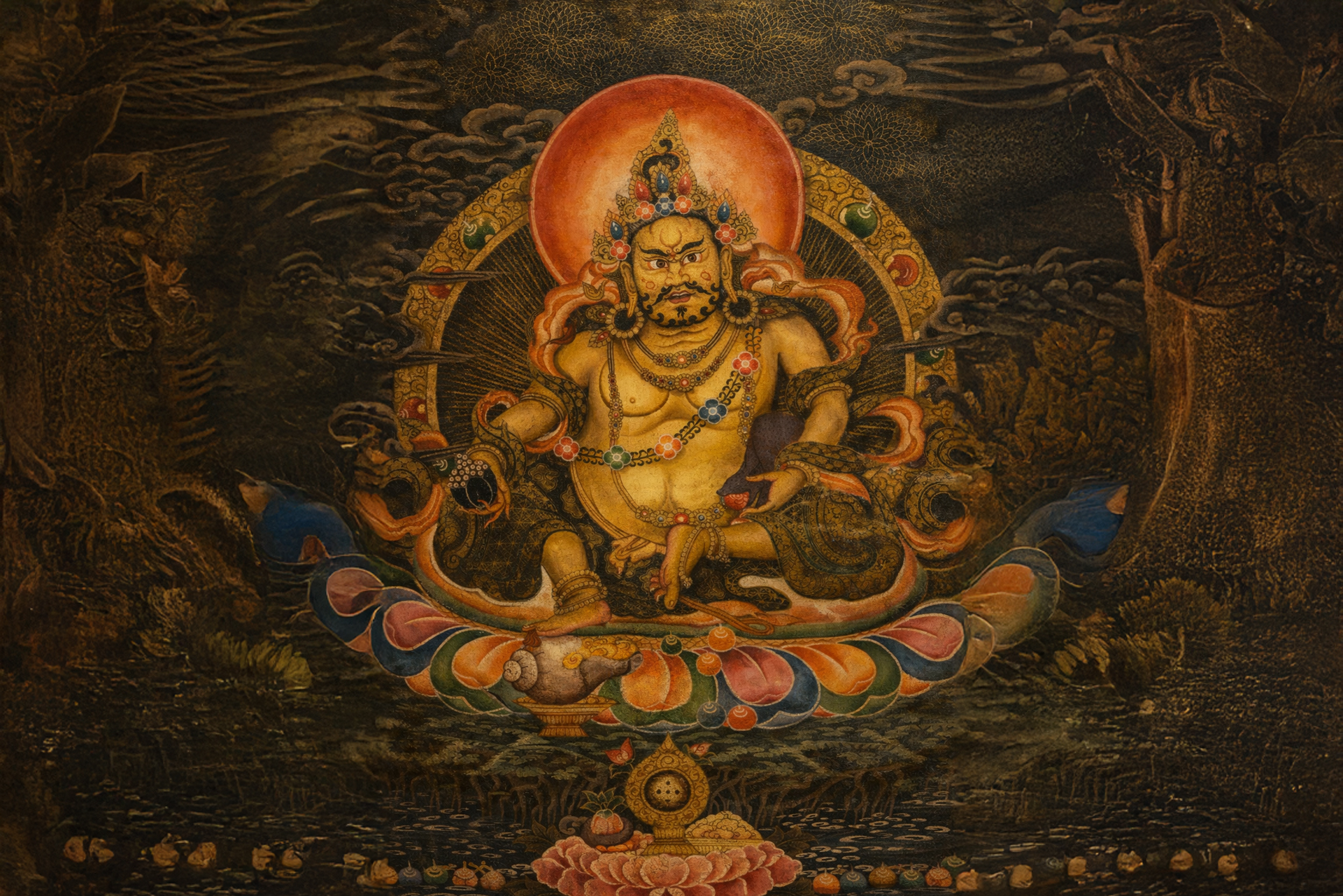
The Yellow Jambhala (Ser gyi Dzambhala) is the most widely practiced form. He holds a mongoose (nakula) in his left hand. The mongoose spits jewels. In his right hand he holds a wish-fulfilling jewel (chintamani). He sits atop a snow lion or sometimes a dragon. Yellow corresponds to the earth element, to ripening, to the consolidation of resources. Most common Jambhala mantras in circulation refer to this form.
The White Jambhala (Karpo Dzambhala) is associated with the Kagyu lineage and carries a specific connection to the removal of poverty through purification of negative karma. He is depicted seated on a dragon, connected to the water element and the action of purifying obstructions.
The Black Jambhala (Nagpo Dzambhala) appears in wrathful form. Associated with the subjugation of forces that obstruct prosperity, his practice is more restricted and transmitted within specific tantric contexts.
The Red Jambhala (Marpo Dzambhala) is linked to the magnetizing (dbang) activity of the four enlightened actions, drawing resources and favorable conditions toward the practitioner and their community.
The Green Jambhala is the least commonly encountered of the five, associated with all-accomplishing activity and sometimes treated as a manifestation of Karma Heruka energy.
The mantra Om Zambala Zolentaye Soha is most frequently attributed to the Yellow Jambhala, though variations of it appear across multiple lineages in association with different forms.
Sanskrit mantras in the Vajrayana tradition are not decoded the way sentences are. They operate simultaneously as phonetic invocations, as compressed doctrinal statements, and as sonic forms of the deity’s energy. With that said, the grammatical content is worth examining.
OM is the universal opening syllable of Sanskrit mantras. It is the pranava, the primordial sound that traditionally signifies the totality of existence and marks the transition from ordinary speech into sacred invocation. In Vajrayana, OM corresponds to the body of all Buddhas and is the first of the three-syllable formula OM AH HUM that appears across tantric liturgy.
ZAMBALA (also Jambhala) is the name of the deity being invoked. Etymologically, the name derives from the Sanskrit jambhara, a citron or lemon fruit, which in iconographic tradition Jambhala holds or is associated with, symbolizing abundance. Some scholars also connect it to jambha, meaning “to overcome” or “to crush,” in the sense of crushing poverty and scarcity.
ZOLENTAYE is where the mantra becomes linguistically interesting. This is a Tibetan phonetic rendering that corresponds approximately to the Sanskrit jalendraye or in some scholarly reconstructions to a corrupt form of a longer invocational phrase. The core element is frequently analyzed as a dative form meaning “to the one who is sovereign over waters” or “to the lord who bestows flow.” Water in Indian and Tibetan cosmology is the primary metaphor for wealth, flow, and nourishing abundance. The naga beings, who guard underground treasure and govern rainfall, are the custodians of material prosperity in this worldview. Jambhala’s connection to the naga realm is structural, not incidental.
SOHA (Skt. svaha) is the concluding syllable of most female-energy or earth-directed mantras in the Vedic and later tantric tradition. It signifies “may it be established,” “so be it,” or more precisely “into the fire” in its Vedic ritual context, indicating an offering being made. In Vajrayana, soha marks the sealing of the mantra’s intention, its delivery into reality.
The mantra as a whole can be understood as: OM — to Jambhala, sovereign lord of flowing abundance — may it be established. But this translation, like all mantra translations, is a shadow of the actual function.
Locating the exact scriptural origin of this specific mantra formulation is not straightforward. Tibetan mantra traditions often exist in a complex relationship between canonical texts and living oral lineages, with the latter sometimes preserving versions that differ from available written sources.
The broader Jambhala tantra material exists within the Tibetan Kangyur and Tengyur, particularly within the kriya tantra category, which governs outer ritual practice including purification, offering, and the invocation of worldly protective deities. Rene de Nebesky-Wojkowitz’s foundational study Oracles and Demons of Tibet (1956) and Martin Willson and Martin Brauen’s Deities of Tibetan Buddhism (2000) provide the primary academic mapping of Jambhala’s appearances in the canonical literature.
The specific formula Om Zambala Zolentaye Soha appears to be most widely transmitted through the Kagyu and Gelug lineages in the context of water offering (chu sbyin) rituals, where water is poured or blessed as an act of invoking abundance. The rationale connects to the naga relationship: water is the element over which nagas have jurisdiction, and blessed water carrying Jambhala’s mantra is understood to activate both the deity’s protection and the naga-treasury connection simultaneously.
Some scholars of Tibetan ritual, including Geoffrey Samuel in Civilized Shamans (1993), note that Jambhala practices in Tibetan village and monastic contexts functioned simultaneously as practical resource-securing rituals and as merit-generating practices, with the boundary between the two not always clearly maintained.
No study of Jambhala’s mantra is complete without attending to his iconographic attributes, because in Vajrayana the visual and sonic dimensions of a deity’s presence are understood as inseparable expressions of the same reality.
The mongoose is Jambhala’s most distinctive attribute. Its Sanskrit name nakula identifies it as a specific species, but its symbolic function is precise: the mongoose is the natural predator of snakes. Since nagas (serpent beings) are the guardians of underground treasure, a mongoose that spits jewels represents the subdued naga releasing its hoarded wealth into circulation. The spitting action is significant: it is not that the practitioner takes the wealth. It flows out spontaneously when the obstructing force is removed.
This is the central model of all Jambhala practice. The goal is not to acquire wealth through the deity’s favor. The goal is to remove the karmic and environmental obstructions that prevent the natural flow of prosperity from reaching the practitioner and those they benefit. Jambhala does not manufacture abundance from nothing; he restores the conditions under which existing abundance can move.
The jewel (norbu, chintamani) in his right hand represents wish-fulfillment at the level of ultimate needs, not merely conventional desires. In the Mahayana framework, the ultimate wish is liberation from suffering for all beings. The jewel that fulfills wishes is ultimately the Dharma itself.
Within Tibetan Buddhist ritual practice, the Jambhala mantra appears in several distinct contexts, and knowing the context matters for understanding what the practice is actually doing.
In water offering practice, a bowl or vessel of water is blessed with the mantra, often repeated a minimum of 21 times. The water is then poured into a river, stream, or natural body of water. The blessing is understood to travel through the water system, reaching the nagas who govern underground wealth and purifying the relationship between the practitioner and those beings whose cooperation is required for material prosperity to manifest. This practice is found widely across Tibetan regions and is notably recommended in the Kagyu tradition as a remedy for persistent financial difficulty rooted in naga-related karma.
In feast offering practice (ganachakra), Jambhala mantras are recited during the blessing of food and drink offerings. Here the function shifts toward merit accumulation and the purification of one’s relationship with material goods — releasing the psychological and karmic contraction around wealth that perpetuates scarcity.
In visualization practice, more elaborate sadhana texts instruct the practitioner to visualize Jambhala in full iconographic detail, merge awareness with his form, and recite the mantra as an expression of identity with the enlightened quality he embodies. This belongs to the yidam practice register and requires proper transmission and instruction.
It is worth noting explicitly: Tibetan teachers uniformly emphasize that Jambhala practice functions within the framework of ethics and generosity. The traditional instruction is that practitioners who engage Jambhala practices must also actively give — to teachers, to the poor, to the support of the Dharma. Without this, the practice operates against itself. Accumulation without generosity is the very pattern that Jambhala practice is designed to dissolve.
For a reader unfamiliar with the Buddhist worldview, the idea of using a mantra to address financial difficulty may seem like magical thinking. The tradition’s actual claim is more nuanced.
Tibetan Buddhist philosophy holds that present circumstances arise from the confluence of prior causes (karma) and conditions (pratyaya). Material poverty, in this framework, is understood as having specific karmic roots: typically, prior actions of theft, breaking generosity, failing to honor financial or energetic debts, or disturbing the naga realm through pollution and disrespect of natural sites. These are not moral accusations. They are understood as mechanistic causes, as structural as the physical laws that govern ordinary causation.
Jambhala practice, in this framework, functions by purifying these prior causes at the level at which they operate: the level of karmic imprint. The mantra is understood as a purification agent, a generator of the specific merit (bsod nams) that counteracts the specific causes of scarcity, and an invocation that re-establishes the practitioner’s energetic relationship with the forces of natural abundance.
This is why the practice does not promise immediate material results. It addresses causes. Results depend on conditions ripening. A farmer who plants seeds in cleared and fertilized ground still cannot force the harvest before its season.
The mantra Om Zambala Zolentaye Soha circulates today in a context its originators could not have anticipated: YouTube videos with “powerful mantra” in the title, wealth-attraction apps, social media posts promising financial miracles within days of recitation.
This is not entirely wrong, and it is not entirely right.
The mantra is genuine. The tradition behind it is substantive and ancient. But the extraction of the sonic formula from its ethical, philosophical, and relational context removes the very mechanism through which it is understood to work. A mantra recited without any understanding of Jambhala’s nature, without generosity practice, without the karmic framework, without proper motivation, is — in the view of most Tibetan teachers — at best neutral and at worst a reinforcement of the very grasping mind that creates material suffering in the first place.
The tradition is not against using the mantra widely. What it insists on is that the practitioner understand what they are doing and why.
For a reader who wants to go deeper, several accessible and reliable resources are available.
Tulku Urgyen Rinpoche and his lineage have produced accessible teachings on wealth deity practice that ground the practical elements in clear philosophical context. His transmissions are documented and recorded.
Lama Zopa Rinpoche’s Foundation for the Preservation of the Mahayana Tradition (FPMT) offers published sadhana texts for Yellow Jambhala with accompanying commentary, transmitted through the Gelug lineage.
Chagdud Tulku Rinpoche’s writings in Gates to Buddhist Practice offer useful background on the role of worldly protectors within Vajrayana without requiring prior technical knowledge.
For academic depth: Robert Beer’s The Handbook of Tibetan Buddhist Symbols (2003) provides comprehensive iconographic analysis. Per Kvaerne’s work on Tibetan religious art and the sNying rje chen po tradition offers rigorous historical context.
For the naga dimension specifically, Rene Nebesky-Wojkowitz’s Oracles and Demons of Tibet remains the most thorough available treatment of how these beings are understood to interact with human prosperity and ritual.
Stripped of both superstition and cynicism, what this mantra offers is specific and valuable.
It is a structured method for reorienting one’s relationship with material reality. Through the act of deliberate recitation, through understanding the deity’s symbolic content, through the generosity practices the tradition attaches to it, the practitioner is invited to examine and gradually dissolve the contraction around material lack — the fear, the grasping, the hoarding mentality that, according to this tradition, is itself the primary cause of perpetuated scarcity.
The lion’s roar that Manjushri embodies breaks through delusion in the domain of ultimate reality. Jambhala’s mantra operates in the domain of relative reality, of this life, these circumstances, these material conditions. Both are understood as aspects of the same awakening project.
Om Zambala Zolentaye Soha. To the sovereign of flowing abundance: may it be established.
The instruction, in the end, is simple. Give. Practice. Understand what you are doing. And recite.
Primary references: Martin Willson and Martin Brauen, Deities of Tibetan Buddhism (2000); Robert Beer, The Handbook of Tibetan Buddhist Symbols (2003); Rene de Nebesky-Wojkowitz, Oracles and Demons of Tibet (1956); Geoffrey Samuel, Civilized Shamans (1993); FPMT Yellow Jambhala Sadhana (Lama Zopa Rinpoche transmission).


