
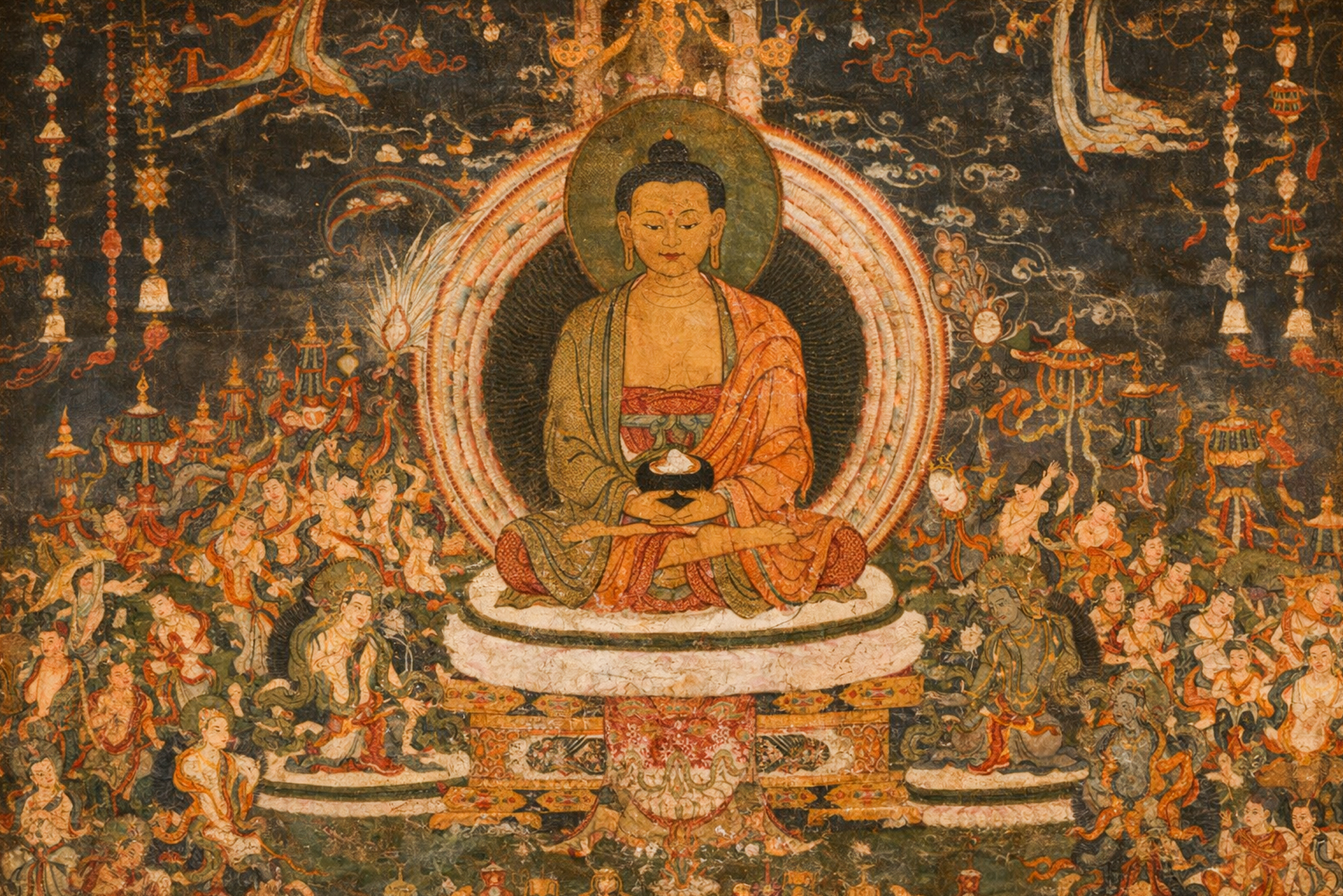
Amitabha Buddha
This mantra is recited at deathbeds. It is whispered into the ear of the dying. It is chanted in cremation rituals, printed on prayer flags that dissolve in wind, carved into mani stones along mountain passes. No other mantra in the Tibetan tradition is so consistently present at the boundary between this life and whatever follows it.
OM AMI DEWA HRIH is the short mantra of Amitabha Buddha (Tib. Öpame, འོད་དཔག་མེད།, “Boundless Light”). Understanding why this particular formula carries such weight requires understanding who Amitabha is, what his Buddha-field represents, and why Tibetan Buddhism treats the moment of death as the most critical moment in any practitioner’s entire spiritual career.
Amitabha is one of the Five Dhyani Buddhas (Tib. Rigna Gyalpo, the five wisdom kings) that form the architectural spine of Vajrayana cosmology. Each of the five represents a primordial aspect of enlightened awareness, a transformation of one of the five fundamental poisons of the mind into its corresponding wisdom.
Amitabha occupies the western direction. His poison is raga, translated variously as desire, attachment, craving. His wisdom is discriminating awareness (pratyaveksana-jnana): the capacity to perceive each phenomenon in its unique particularity, clearly and without grasping. The poison and the wisdom are not opposites. They are the same energy in two different states — contracted and open.
His color is red. Red in this iconographic system does not signify danger or aggression. It signifies magnetism, warmth, the drawing-in quality of the setting sun in the west. His element is fire. His symbol is the lotus (padma), and the entire Padma family of Vajrayana — which includes Avalokiteshvara and Padmasambhava — traces its lineage through him.
He holds a begging bowl (patra) in his lap, both hands resting in the meditation mudra. This is significant. Among the five Dhyani Buddhas, Amitabha’s gesture is the most inward, the most settled. He does not display a sword, a wheel, a vajra. He simply rests. This resting quality is itself a teaching about the nature of his wisdom: not acquired through effort but recognized through stillness.
Amitabha’s domain is Sukhavati (Tib. Dewachen, བདེ་བ་ཅན།), the “Realm of Great Bliss.” In Tibetan Buddhist cosmology this is not a metaphor and not a posthumous reward for good behavior. It is a Buddha-field (buddhakshetra): a domain of reality purified by the accumulation of a Buddha’s merit and wisdom over countless eons, in which the conditions for awakening are maximally favorable.
The canonical sources for Sukhavati are the Sukhavativyuha Sutras, both the longer and shorter versions, which describe Amitabha’s original vow as the bodhisattva Dharmakara. Before becoming a Buddha, Dharmakara made forty-eight vows, the most significant of which was the eighteenth: that any being who sincerely calls upon his name at the moment of death, with genuine faith and aspiration, will be received into Sukhavati and will not fall back from the path to liberation.
This vow structure is unique in Buddhist literature. It places the mechanism of rebirth into the Pure Land not on the practitioner’s accumulated merit alone but on the Buddha’s own commitment. For practitioners of limited capacity, for those who have not achieved high realization through meditation, this vow offers a path that does not require mastery — only sincere aspiration.
Tibetan Buddhism absorbed this Pure Land orientation deeply, but integrated it within the broader Vajrayana framework rather than treating it as a separate vehicle. The result is a practice tradition in which Amitabha is simultaneously a yidam for advanced Vajrayana practitioners and an accessible refuge for practitioners at every level.
OM opens, as it opens all such formulas. Body, speech, and mind of all Buddhas. The transition from ordinary to sacred register. No further elaboration is needed here; its function is structural and has been discussed in earlier contexts.
AMI is the first element of Amitabha (Amita + bha). Amita in Sanskrit means “boundless,” “immeasurable,” “without limit.” The full name Amitabha means “Boundless Light.” A parallel name, Amitayus (Tib. Tsepame, ཚེ་དཔག་མེད།), means “Boundless Life.” These two names refer to the same buddha-nature quality expressed in two aspects: light as wisdom, life as the dynamic continuity of awareness. In practice, Amitabha and Amitayus are distinct iconographic forms used in different ritual contexts — Amitabha primarily in death and rebirth practices, Amitayus in longevity practices — but they are understood as two faces of a single reality.
DEWA is the Tibetan rendering of Sanskrit deva or deva-, but in this context it is functioning as a phonetic compression of the second half of Amitabha — the bha element, meaning “light” or “splendor.” Some scholars analyze the full AMI DEWA as a Tibetanized contraction of Amitabha itself, preserving the sonic body of the name across linguistic translation. This is consistent with how many Sanskrit names travel into Tibetan liturgy: not as translations but as phonetic approximations that retain the mantra’s energetic signature while adapting to Tibetan phonology.
HRIH is the seed syllable (bija) of Amitabha. This single syllable is the most compressed possible sonic expression of Amitabha’s entire buddha-nature quality. In Vajrayana theory, the seed syllable is not a symbol pointing to the deity — it is the deity in its most essential form. HRIH is the sound of discriminating awareness, of the wisdom that perceives without grasping, of the red lotus opening in the west. It appears at the heart of Amitabha’s visualized form in meditation, radiating light.
The mantra’s internal movement, then, is: opening invocation — the name of the boundless one — the seed of that boundlessness itself. It begins in space, moves to identity, and arrives at essence.
No understanding of this mantra is complete without the practice of Phowa (Tib. འཕོ་བ།), the transference of consciousness at death. This is the primary practice context in which OM AMI DEWA HRIH functions as an operative rather than merely devotional formula.
Phowa is classified in Tibetan Buddhism as one of the Six Yogas of Naropa, the same cycle that includes tummo (inner heat) and dream yoga. It is considered a high practice — and simultaneously one of the most accessible, because its results can be verified in this life through specific physical signs that arise during intensive practice.
The basic mechanics of Phowa: at the moment of death, consciousness exits the body through one of several possible apertures. The aperture of exit determines the quality of rebirth. Exit through the crown of the head (brahmarandhra) is considered the optimal pathway, leading toward liberation or rebirth in a Pure Land. Exit through lower apertures leads to rebirth in less favorable states.
Phowa practice trains the consciousness, during life, to exit through the crown. The visualization involves Amitabha Buddha appearing above the crown of the head, the practitioner’s own consciousness as a small sphere of light, and the repeated practice of ejecting that sphere upward and merging it with Amitabha’s heart center. The mantra OM AMI DEWA HRIH accompanies each ejection — it is the sonic vehicle of the transfer.
What makes Phowa remarkable from a cross-cultural perspective: it is not about surrendering to divine grace passively. It is a skill acquired through deliberate training. The practitioner is building a neural and energetic habit pattern — a deeply conditioned reflex — so that at the moment of death, when the ordinary mind dissolves and the window of bardo opens, the consciousness has been so thoroughly trained in this direction that it moves naturally toward Amitabha’s field without needing to think.
The mantra is the track on which that movement runs.
To understand why this mantra matters so much, the Tibetan understanding of the post-death state requires brief explanation.
The Bardo Thodol (Tibetan Book of the Dead), attributed to Padmasambhava and revealed as a terma by Karma Lingpa in the 14th century, describes three intermediate states (bardo) through which consciousness passes between death and rebirth.
In the first bardo, immediately after death, the dharmata bardo, the ground luminosity of reality itself flashes: a brilliant, empty, boundless light. This is the naked buddha-nature appearing without obstruction. Practitioners who recognize this light are liberated instantly. Most do not. The light is too sudden, too vast, too unlike anything the habituated mind knows how to relate to.
In the second bardo, peaceful and wrathful deities appear in sequence. Among the earliest to appear are the five Dhyani Buddhas, each offering the light of their wisdom. Amitabha appears offering the soft, warm red light of discriminating awareness. Alongside it, a dull reddish light also appears — the light of the hungry ghost realm, the realm of insatiable craving. The untrained consciousness, habituated to desire, gravitates toward the familiar dull light rather than Amitabha’s brilliant offering.
This is the precise moment for which Phowa practice and the Amitabha mantra prepare the practitioner. Recognition of Amitabha’s light in the bardo is not an intellectual act. It is a recognition born of sustained familiarization during life — a meeting between the consciousness and a quality of awareness it has practiced with, visualized, sounded, and oriented toward thousands of times.
OM AMI DEWA HRIH recited during life is building the pattern of that recognition.
The Amitabha practice tradition spans all four major Tibetan schools, though with different emphases and in different ritual contexts.
In the Nyingma tradition, Amitabha is embedded within the Padmasambhava cycle, since Padmasambhava is understood as an emanation of Amitabha. The Bardo Thodol itself is a Nyingma terma text, and the use of Amitabha mantra and Phowa in death rites is particularly elaborated in this school. Longchenpa’s Seven Treasuries treat the luminous nature of awareness in ways that directly parallel the dharmata encounter described in the bardo teachings.
In the Kagyu tradition, the Amitabha practice is transmitted especially through the Phowa lineage. Milarepa’s realization poetry frequently references the western direction and the red light of Amitabha as the poetic register of awareness recognizing itself. The Kagyu mahamudra approach to death treats the bardo as an opportunity equivalent to any meditation session: the same awareness that recognizes the nature of mind in sitting practice recognizes the ground luminosity in the bardo.
In the Gelug school, the Amitabha practice is systematized within the Lamrim framework. Lama Tsongkhapa’s Liberation in the Palm of Your Hand, as transmitted through Pabongka Rinpoche and Trijang Rinpoche, dedicates substantial sections to Phowa and rebirth in Sukhavati as practices accessible to practitioners who have not achieved high tantric realization in this life.
In the Sakya tradition, Amitabha appears within the Lamdre cycle and in the Virupa lineage’s treatment of luminosity. The Sakya approach particularly emphasizes the inseparability of the practitioner’s mind and Amitabha’s buddha-field — not as a destination but as a quality of awareness already present and to be recognized.
One detail that rewards attention: Avalokiteshvara (Tib. Chenrezig), the bodhisattva of compassion, whose mantra OM MANI PADME HUM is perhaps the most universally known mantra in Tibetan Buddhism, is understood as an emanation of Amitabha. In most iconographic depictions, Avalokiteshvara bears a small image of Amitabha in his crown.
This relationship is not incidental. It means that Tibetan Buddhism’s most pervasive compassion practice and its most pervasive death practice are understood as expressions of a single wisdom-compassion complex. Amitabha is the recognition aspect: boundless light that sees without grasping. Avalokiteshvara is the response aspect: compassion moving without obstruction toward all suffering beings.
For a practitioner who works with both mantras, the Chenrezig practice cultivates the orientation of compassionate attention in life. The Amitabha practice trains the recognition that compassionate attention, followed to its root, is the very awareness that the bardo will demand.
They are not two practices leading to two places. They are two doors into the same room.
Within Tibetan Buddhist daily practice, OM AMI DEWA HRIH is recited in several distinct modes.
The most common is simple repetition: mala beads (threngwa), 108 repetitions per round, accumulated over years. Milions of repetitions are described in biographies of great practitioners, not as a mechanical achievement but as the progressive deepening of familiarization. The sound becomes, through sustained practice, less a recitation and more a quality of attention.
In group practice, the mantra is chanted in unison during group Phowa retreats, which are held regularly in Tibetan Buddhist centers worldwide. The cumulative effect of many practitioners chanting together is understood to amplify the field of Amitabha’s presence, making recognition easier for all participants, including those on whose behalf the practice is being done.
In death rites, a lama or experienced practitioner recites the mantra continuously into the ear of the dying or recently deceased for up to three days after clinical death — reflecting the Tibetan understanding that consciousness does not immediately vacate the body and can still receive guidance during the first stage of the bardo.
Prayer flags (lungta) printed with OM AMI DEWA HRIH are hung so that wind carries the mantra’s vibration across the landscape. The logic: all beings within range of that vibration receive a seed-impression of Amitabha’s quality, however subtle, which accumulates across lifetimes.
It is worth pausing on a common misunderstanding, particularly prevalent in Western Buddhist contexts.
Amitabha practice is sometimes categorized as “devotional Buddhism” in contrast to “philosophical Buddhism” or “meditation Buddhism,” with an implicit hierarchy that places devotional practice at a lower level. This categorization misrepresents the tradition.
In the Tibetan framework, devotion (Tib. mos gus) is not a substitute for understanding. It is a specific mental factor that removes the resistance to recognizing what already is. The practitioner who recites OM AMI DEWA HRIH with full understanding of discriminating awareness wisdom, Phowa mechanics, bardo navigation, and the inseparability of Amitabha’s field from the practitioner’s own awareness is doing something technically complex and philosophically sophisticated. The simplicity of the formula is not evidence of intellectual shallowness. It is evidence of how efficiently centuries of practice tradition have distilled an entire view of reality into a sonic key.
The mantra works by familiarity. It works by repetition. It works by the accumulated weight of sincere aspiration meeting a genuine compassionate vow. None of that is primitive.
For practitioners and researchers who wish to engage this tradition seriously, the primary textual resources are substantial.
The Sukhavativyuha Sutras in translation — both the longer and shorter versions — are the foundational canonical texts. Luis Gomez’s The Land of Bliss (1996) provides rigorous scholarly translation and analysis of both sutras with comprehensive historical context.
Sogyal Rinpoche’s The Tibetan Book of Living and Dying (1992) remains the most widely accessible treatment of the bardo teachings and Phowa practice for general readers, though it should be supplemented with the original Bardo Thodol translation by Chogyam Trungpa and Francesca Fremantle for textual precision.
Khenchen Thrangu Rinpoche’s commentaries on Phowa practice, available through Namo Buddha Publications, offer a rigorous Kagyu-lineage treatment that balances doctrinal precision with practical instruction.
For the Five Dhyani Buddha framework within which Amitabha is situated: Chogyam Trungpa’s The Dharma Ocean Series and his Orderly Chaos address the mandala principle with unusual philosophical depth.
For serious Phowa practice: transmission from a qualified teacher is required. The physical signs of successful Phowa training — a small opening or sensitivity at the crown of the head — are verifiable and serve as a form of practice feedback unavailable in most other Buddhist meditation traditions.
There is a reason Amitabha’s pure land is placed in the west. In Indian and Tibetan cosmological imagination, west is where the sun goes at the end of the day. The setting sun does not fail or extinguish. It completes its arc. What looks like ending is transition.
The practitioner who recites OM AMI DEWA HRIH is, in one sense, rehearsing that transition. Not with dread. Not with grasping for continuation. But with the specific quality of attention that recognizes the light still present at the horizon even as form dissolves.
Every recitation is practice for the moment that cannot be avoided.
And the tradition’s entire argument is that a moment practiced for, genuinely and repeatedly, does not arrive as a stranger.
Primary references: Luis Gomez, The Land of Bliss (1996); Sogyal Rinpoche, The Tibetan Book of Living and Dying (1992); Chogyam Trungpa and Francesca Fremantle (trans.), The Tibetan Book of the Dead (1975); Khenchen Thrangu Rinpoche, Phowa Commentary (Namo Buddha Publications); Robert Beer, The Handbook of Tibetan Buddhist Symbols (2003); Lama Lodro, Bardo Teachings (1982).


